

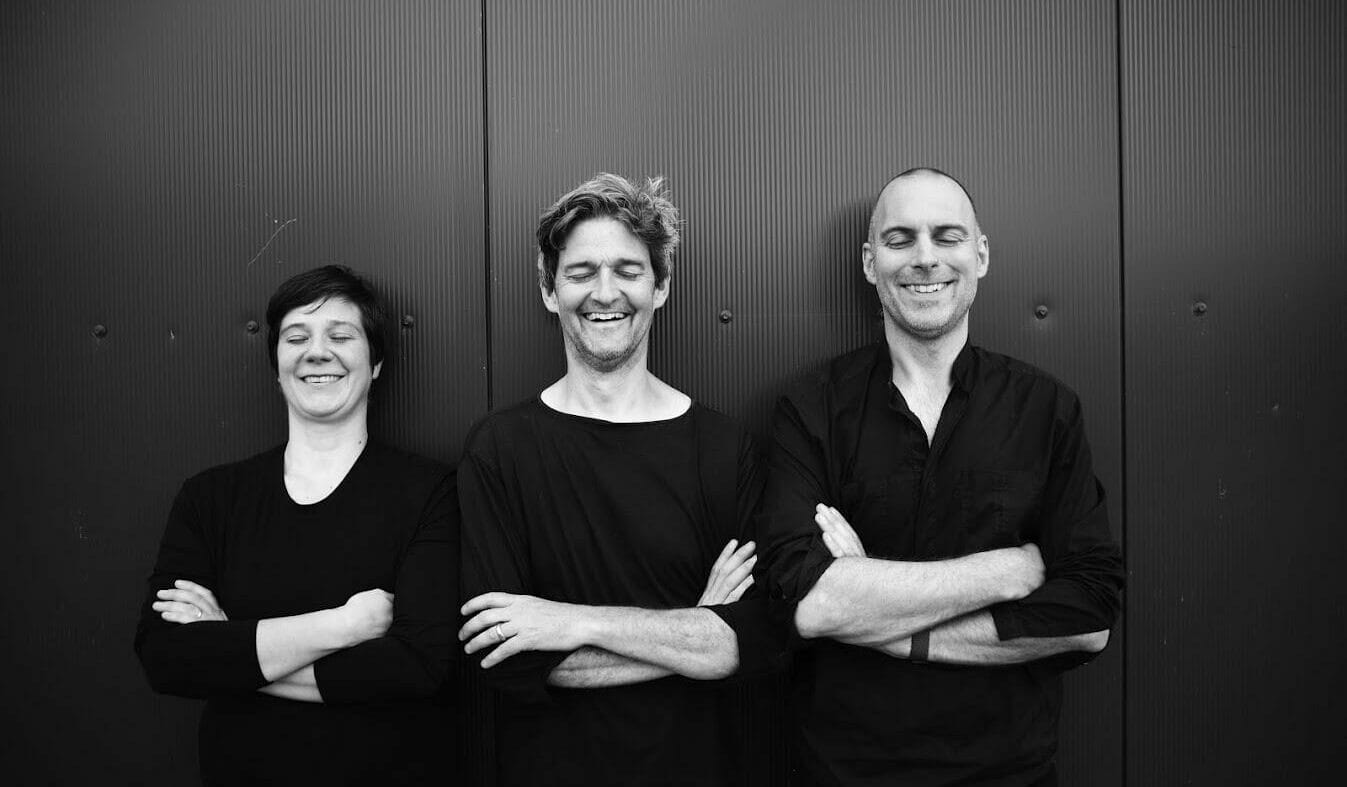
The Collective
Sounding Situations
Sounding Situations develops highly innovative music theater where the performers and musicians, the auditive and the audience meet in both physical and imaginary space for artistic action. Their projects create moments where political art, current questions of our society, reality, utopia, and artistic magic merge into a multilayered artwork.
Often the group works between countries, continents, and cultural boundaries in trans-traditional experiments hence overcoming challenges and revealing the beauty of our shared human existence.
Since 2014 the collective explores theatrical situations between theater, staging and music. Live processing of original musical material, instruments, field recordings and language sounds are connected to a unique composition. The work always looks for a strong relation to the environment in its material, acoustic and political context. Collaborations range from musicians to choreographers, visual artists, authors, theater and film directors.
The long term work brought the group presented their projects at Haus der Kulturen der Welt, Kampnagel Hamburg, Humboldt Forum, Deutsch Oper/Tischlerei and performed in Germany, Italy, Belgium, Canada, Brasil, Denmark, Uganda, Israel, Rwanda and other places around the world.
Milena Kipfmüller was born and grew in Brazil, where she studied oboe and piano. After moving to Germany she decided to continue her studies at the faculty of applied theatre studies in Giesen with Heiner Goebbels, Xavier Le Roy,
Mathilde Monnier, Antonio Araújo and where she focused on sound, radioplays and dramaturgical work. Her works blend different media together and approach often political and current questions. She was scholarship holder on the program for young European artists, curators and
producers (Festival in Transition). Her radioplay “Hate Radio” about the Rwandan genocide won the Hörspielpreis der Kriegsblinden 2014. She got a fellowship of Robert Bosch Stiftung and collaborated with groups such as matthaei&konsorten, Gob Squad, was founding member of sounding situations and IIPM. // www.milenakipf.de //
Klaus Janek combines the doublebassplaying with electronics as compositional tools. He collaborates extensively with movement, spoken words and music theater, seeking the balance between aesthetics and discourse. He performed at the Louvre, Berghain, CTM, Impulstanz and many other places and festivals, tours regularly in all continents, earned a scholarship from Robert Bosch Stiftung and grants from culture exchange office Berlin and culture office, Bolzano. – // www.klaus-janek.de //
Jens Dietrich works as curator and freelance dramaturge. He studied Applied Theatre Studies in Giessen under the director and composer Heiner Goebbels. During and after his studies, he worked at Richard Foreman’s Ontological Theater in New York as well as at the Bühnen der Stadt Köln and the Theater Freiburg. Since 2004 he is active in various international collaborations. 2009 he joined the International Institute of Political Murder (IIPM). 2014 he founded the group “Political Bodies” together with Yolanda Gutiérrez. He curated the Russian Performing Arts section of the Nordwind Festival 2015. In 2016 he joined Sounding Situations and co-directed the audio play “Kunst im Verhör” (WDR) together with Milena Kipfmüller and the walkable music theatre “Rwandan Records”, which premiered at the HKW Berlin in 2019. – // www.jens-dietrich.com //
Micaela Trigo is a Portuguese-Brazilian cultural producer based in Berlin. Her work focuses on connecting artists, ideas and people, accompanying artistic projects across dance, performance, theatre and music from development to presentation.
Through production, strategic thinking and cultural mediation, she works to create sustainable pathways for artistic practices while fostering dialogue and exchange between artists, institutions, festivals and communities.
She believes that art is a space for encounter, reflection and transformation, and approaches production as a practice of care, listening and relationship-building. Her work is guided by a commitment to supporting projects that engage with social, political and human questions through artistic expression.
Artist; composer / sound designer; lighting designer for theatre, dance and circus; technical manager for devised theatre; field recordist; concert / event organiser; mail art curator; radio presenter and DJ: operating in various fields of art and performance since the mid-1980’s; born in Cardiff, Wales.
Co-artistic director with Paul Hodson (The Future Is Unwritten) of Theatre FC, creating theatre events for & with non-league football clubs and their supporters; technical manager / lighting designer for Gob Squad, the Berlin-based multi-media theatre company; technical consultant / lighting & sound designer for artistic director / choreographer Andreas Wegwerth (formally of Residance of the Peter Gläsel Stiftung); lighting & sound designer for UK theatre companies Prodigal / UPG and The Future Is Unwritten; and band member of Animal Magic; LuTz and Wevie Stonder.
Has previously worked with Matthaei & Konsorten; Jens Dietrich & Milena Kipfmueller & SNDNG STTNS; Milo Rau / IIPM; Royston Maldoom; Tanzmoto; Katja Dreyer; Darren Johnston / Array; Liz Aggiss; Divas Dance Theatre; Periplum; Tim Crouch; Slot Machine; Silvia Mercurali; Sarah Nicolls; Talia Randall; Tchekpo Dance Company; The Ragroof Players; Inspector Sands; Vincent Dance Theatre; Matilda Leyser & John-Paul Zaccarini; Bright FX; Swamp Circus; The People Show & The Royal Shakespeare Company.
Sarah Rosenau is a Berlin-based press and public relations specialist working at the intersection of independent performing arts, music and socio-political discourse. She has developed communication strategies and press campaigns for institutions and projects including English Theatre Berlin, RomaTrial e.V. and ROMADAY in cooperation with Maxim Gorki Theater/Studio Я, as well as numerous productions within Berlin’s independent scene and beyond. In 2024, she co-founded Das Kombinat e.V., an intercultural association operating in the fields of art and culture, youth work, and empowerment. Between 2022 and 2024, she developed a detailed PR strategy for Grüner Salon der Volksbühne am Rosa-Luxemburg-Platz, taking over this role again in February 2026. Her work translates complex artistic and political subject matter into precise public language, accompanying projects from conceptual development through premiere and beyond. For Sounding Situations, she leads press and public relations, shaping the public resonance of the collective’s research-based music theatre.
Stephanie Roderer is a Munich-based art director and designer and founder of her own Büro für visuelle Gestaltung. She conceives and designs books, catalogues, magazines, posters, visual identities and websites, with a particular affinity for the arts: working closely with artists, she develops ideas and concepts for performances and installations, understanding design as a form of thinking alongside the work rather than merely packaging it. After several years in studios and agencies, she has run her own practice since 2011 and is a partner in the design network PingPong, which brings together graphic design, illustration, photography and programming.
Collaborators
Hauke Heumann, born in Lübeck, studied German and Gender Studies in Hamburg and Berlin, and drama at the Berlin University of the Arts (UdK). He lives and works as a freelance actor in Berlin and was a scholarship holder of the International Forum of the Theatertreffen in 2012. He collaborates regularly with 1pp1, La Fleur, Sebastian Blasius, costa compagnie, Sounding Situations and others at Kampnagel Hamburg, HAU Berlin, FFT Düsseldorf, Neumarkt Theatre Zurich, Theater Bremen, Ballhaus Ost, Vierte Welt, Theater Freiburg, Theater Rampe and elsewhere. He played the Frog in Johann Strauss’s ‘Die Fledermaus’ directed by Felix Rothenhäusler. With Gintersdorfer/Klaßen, he was invited to the Skulptur Projekte Münster 2017, the “Politik im freien Theater” festival, the Festival d’Avignon and three times to the Tanzplattform. His most recent film work includes “L’État et moi” (2022) by Max Linz and “Die Amitié” (2023) by Peter Ott and Ute Ott-Holl; in the documentary field, he appears as a presenter in “Die Kunst, viele zu bleiben” (2025) by Felix Meyer-Christian. He is a founding member of 1pp1 and presents his own work in this context. www.1pp1.org www.haukeheumann.com
Katsia Kaya is a Belarusian voice artist, performer and researcher based in Berlin, working across opera, somatics and socially engaged art. Trained in choir conducting and solo singing, with a decade of experience in contemporary dance and contact improvisation, she develops a practice in which the voice is inseparable from the body that carries it. Her work has been presented in collaboration with institutions including the Akademie der Künste, Deutsche Oper Berlin and Kampnagel. As founder of bodyvoice.art, she also works with activists and human rights defenders, exploring the voice as an instrument of presence, resilience and resistance.
The Berlin-based clarinetist/composer/performer Michael Thieke is equally at home across a broad range of musical environments, such as experimental song forms, collectively composing projects, improvising collectives, and music on the fringes of jazz. He is exploring the minutiae of sound, timbre and noise, with a particular interest in microtonality and related sound phenomena. The qualities of slowness are another field of his research. He has a preference for long-term collaborations and collective work.
Some of his current Projects are: The International Nothing (with Kai Fagaschinski), Voutchkova/Thieke Duo (with Biliana Voutchkova), The Pitch (with Boris Baltschun, Koen Nutters, Morten J. Olsen), Der lange Schatten (with Håvard Wiik, Antonio Borghini), Splitter Orchester, Magda Mayas Filamental (with Magda Mayas, Angharad Davies, Christine Abdelnour, Zeena Parkins, Rhodri Davies, Aimee Theriot, Anthea Caddy), Porta Chiusa (with Paed Conca, Hans Koch), The Clarinet Trio (with Gebhard Ullmann, Jürgen Kupke), The Magic I.D. (with Christof Kurzmann, Kai Fagaschinski, Margareth Kammerer), Marino/Thieke (wth Luigi Marino), Nashaz (with Sharif Sehnaoui, Andrea Neumann, Michael Vorfeld), Warteland (with Lena Czerniawska, Emilio Gordoa)
He played on festivals such as Novas Frequencias (Rio de Janeiro), Borderline (Athens), Ring Ring (Belgrade), Wien Modern, Uppercut (Bordeaux), Klub Katarakt (Hamburg), Irtijal (Beirut), Ftarri Festival (Tokyo), Meakusma (Eupen), Seanaps (Leipzig), Festival International de Musique Actuelle (Victoriaville), Taiwan Improvised Music Festival (Tapei), Huddersfield Contemporary Music Festival, Musikprotokoll (Graz), Klangspuren (Schwaz), Trans Art (Bozen), Music Unlimited (Wels), Jazz Fest (Berlin), MärzMusik (Berlin), Borealis (Bergen), Musica Estranha (Sao Paulo), ctm (Berlin), Crak (Paris), Darmstädter Ferienkurse Für Neue Musik (Darmstadt), Sonic Acts (Amsterdam), Taktlos (Zürich), Metéo (Mulhouse), Angelica (Bologna), Alternativa (Prague), Konfrontationen (Nickelsdorf), Musiques Innovatrices (St.Etienne), artacts (St.Johann), Experimental Intermedia (New York), Long Arms (Moscow), Controindicazione (Rome), Moers Festival, Donaueschinger Musiktage, ZJFT (Groningen), Jazz em Agosto (Lisbon), PiedNu (LeHavre)
Elena Kakaliagou has developed her own language on the horn: lyrical and melancholic, fierce as a stormy sea or calm as a breath of wind. Kakaliagou gives acoustic and amplified solo concerts, with or without voice depending on the venue. The classically trained horn player offers a new approach to her instrument — melodic, microtonal, quiet, singing, and always open to spontaneity.
There are musicians who masterfully manage the balancing act between musical agility and technical perfection. Elena Margarita Kakaliagou (GR/AT) is one such musician. With apparent effortlessness, the experienced and versatile improviser moves between styles. Her outstanding technique and her continuous work on sound make her a sought-after collaborator on the international stage. Her trademarks are her artistic openness, her very personal sense of timing, and her powerful, warm tone.
Kakaliagou studied horn in Athens (GR) and Graz (AT). She completed her Master’s degree at the Sibelius Academy in Finland. In 2010, she chose Berlin as the base for her freelance artistic career. She is a member of the ensembles Zinc & Copper and zeitkratzer, as well as a co-founder of the Rank Ensemble, the trio Para, and the duo Nabelóse.
Elena Kakaliagou’s playing is maximally sound-oriented, her music always organic. She moves between tonality and noise-like, percussive sounds. This expert in microtonality impresses with a strong stage presence and a lightness in playing that is entirely her own. Kakaliagou’s particular interest lies in contemporary music and free improvisation; she has no reservations whatsoever toward other artistic disciplines. Folk, jazz, classical music, and other musical genres serve as sources of inspiration for her. She regards the boundaries between genres as non-existent.
Hannes Teichmann is a Berlin-based DJ, electronic live musician, curator, and cultural activist. Together with his brother Andi Teichmann, he forms the duo Gebrüder Teichmann, a cornerstone of Berlin’s underground electronic scene since the late 1990s. Raised by a free jazz musician father, the brothers began performing together in childhood and have since toured in over 30 countries, with appearances at venues ranging from Berghain and the Neue Nationalgalerie to festivals in Siberia, Kenya, Angola, Japan, and beyond. Their label Festplatten Records and intercultural projects such as BLNRB and Ten Cities — developed in collaboration with the Goethe-Institut — reflect a practice rooted in cross-genre dialogue and global exchange.
Doris Dziersk is a visual artist and scenographer based in Leipzig. She has created stage sets and installations for Meg Stuart, Moriah Evans, Matthaei & Konsorten, Doublelucky and many others, and received a New York Bessie Award for outstanding visual design in 2012. Beyond the stage, she develops spatial concepts for temporary gatherings such as The New Infinity (Berliner Festspiele) and Tanzkongress 2019. Her practice approaches sites and materials through haptic and experiential means, unfolding the possibilities of the overlooked through live transformation and shifting contexts to open a multitude of perspectives for performers and audiences alike.
Severin Renke, born in Belgium in 1979, is a cinematographer and film designer whose moving images appear internationally in theatre and opera productions, documentary art cinema and commercial work. Originally trained as a photographer, working with figures such as Elfi Semotan and Nick Knight, he has been active as an independent filmmaker since 2011. His video work for the stage includes collaborations with Frank Castorf on Der haarige Affe and Der Geheimagent, with Karin Beier on Elfriede Jelinek’s Lärm. Blindes Sehen. Blinde Sehen and Brecht’s Herr Puntila und sein Knecht Matti, all at Deutsches SchauSpielHaus Hamburg, as well as with Kay Voges.
Flavia Wolfgramm is a dramaturg and producer working between music theatre, performance and digital formats. A member of the Hamburg-based f.e.t.t.kollektiv, she has developed projects with PODIUM Esslingen, including the participatory digital theatre work OK Tannhäuser, which reimagined Wagner for the space of social media, and curated the festival’s feminist matinee in 2022. Her dramaturgical practice spans institutions and the independent scene, from the University of Music and Performing Arts Graz to the Hamburg University of Music and Theatre, with a recurring interest in how political questions, feminist perspectives and new technologies reshape the forms of theatre itself.
1key is a multilingual poet, actor, musician, songwriter, producer from East Africa merging various forms of media in his artistic expressions. http://1keyziki.com/
The percussionist Sofia Borges chose a risky but stimulating path: to explore, to experiment, to enlarge the established languages (be it the improvised ones or the composed by herself, with graphic notations extending the conventional writing) and the results are showing us that the art of sounds is not dead yet; far from it. She does it in two ways. One is the solo format – adding objects, some of them of her own invention, music boxes and toys to the jazz drumkit and the orchestral percussion instruments, and also analogic and digital electronic devices enabling her to process, in real time, her acoustic constructions, including in the mix a good number of field recordings. Another is the association with some of the most remarkable spontaneous noisemakers of our time, like Craig Taborn, Mat Maneri, Axel Dörner, Robyn Schulkowsky, Ignaz Schick, Ryeko Okuda, Sanem Kalfa, Michael Thieke, Cansu Tanrikulu, Chris Pitsiokos e Nick Dunston, just to name a few, and integrating unavoidable bands such as SORBD and SLOTSCH.
The Berlin-based, but Portuguese-born inventive sound creator has the stage as her natural environment, establishing music as another of the performative arts. In this context it’s with no wonder that we find Sofia Borges in dance and theatre projects, collaborating with Meg Stuart, Alexis Blake or the collective Sounding Situations. There’s no end in sight for the investigative approaches of her playing with time and space, and that’s the key secret for her growing notability in the international scene.
Josué Mugisha was born in Burundi and is an actor, dancer-choreographer, director and playwright.
After studying performing arts in South Africa, Josué encountered what he calls a „speech crisis“ in Burundi, a term that comes from the fact that people were whispering about political issues because everyone was suspicious of everyone else, that artists were very censored and threatened, that all independent radio stations were burned, etc…
Joshua then began to research other ways of communicating with the public and found a lot of potential in the virtuosity of the bodies through the creation of conceptual images that return reason to the individual through a free, abstract and poetic reading.
Katharina Meves studied at SEAD, Salzburg and was a recipient of the DanceWEB scholarship 2009. In Austria she has performed with Georg Blaschke and Liquid Loft/Chris Haring, e.g. in the Posing Project B – The Art of Seduction, which was awarded the Golden Lion at the Biennale di Venezia 2007. She also acted in the film Burning Palace by Mara Mattuschka and Chris Haring, which received the Kurzfilmtage Oberhausen Prize in 2009. In Germany, she has worked e.g. with Lara Kugelmann, Ingo Reulecke, Lukas Matthaei, Lubricat, Ayat Najafi, Louise Wagner and Anna Malunat. She has also been dancing with the T.r.a.s.h. Dance Company in the Netherlands since 2011.
The Italian-German duo TÒ SU explores transcultural border areas in a global world and deals with Eurocentric perspectives and their own cultural identity. Projects are created in collaboration with experts from art, science and everyday life and are mostly characterized by analogue and digital interactivity, which invite the audience to participate. TÒ SU comes from the Rhaeto-Romanic language, which is spoken by a small community in northen Italy and means “to record, to document, to include”. In Ladin, the two short words form the meaning that arises in interaction and mutual exchange. Prinoth and Mahlknecht combine the two genres of documentary film and theater. In the past, various collaborations have resulted in projects that are hybrids of both genres and have been presented in cinemas, theaters and exhibition spaces. They produce their projects between several countries with a focus on Germany and Italy.
Martina Mahlknecht was born in Bressanone, Italy. She lives and works between Bolzano and Hamburg, Germany. She studied art and stage design at the Academy of Fine Arts HfbK in Hamburg and at the Mozarteum in Salzburg, Austria. Since 2022 she is teaching at the HfbK Hamburg.
Martin Prinoth was born in Rhaeto-Romanic Urtijëi, Italy. He lives between Bolzano and Hamburg. After studying communication sciences at the University of Salzburg, Austria he graduated in film and digital cinema at the Academy of Fine Arts HfbK in Hamburg. He leads film workshops and film seminars i.a. at the UE Hamburg.
Federico Neri, born in Rome in 1985, is a Berlin-based filmmaker and editor. Trained in film direction at the Roma Film Academy in Cinecittà, he went on to study film and art history at Freie Universität Berlin and editing at Film University Babelsberg Konrad Wolf. His documentary and fiction work has screened at festivals including Berlinale, IDFA and Visions du Réel and received awards including a Grimme-Preis. Alongside cinema, he works as a video artist for performance, with projects such as 24 Bilder pro Sekunde by Boris Nikitin at the Wiener Festwochen, exploring the moving image as a space of memory and presence.
Biliana Voutchkova is an interdisciplinary artist, violinist, composer-performer, improviser and curator based between Berlin and the Bulgarian Black Sea coast. Through the prism of listening, she explores states of spontaneity and intuitive resonance, working at the interconnection between inner world and sound space. Her practice spans contemporary composition, site-specific work, long-durational performance and installation, in collaboration with ensembles such as Splitter Orchester, Trickster Orchestra and Ensemble Modern. She has performed worldwide, from Carnegie Hall and the Berliner Philharmonie to galleries and experimental venues, is founder and curator of the DARA String Festival and teaches at the Bern Academy of Arts (HKB).
Christian Kobi is a Swiss saxophonist, improviser and curator whose work explores the relationship between sound, silence and action in space. Through an intensive engagement with improvised music he has developed a highly personal sonic language, turning the saxophone inward to make audible its hidden, almost imperceptible resonances of breath, air and material. He performs internationally as a soloist and with Konus Quartett, in long-term partnerships with artists such as Phill Niblock, Jürg Frey, Taku Sugimoto and Keith Rowe. Founder and artistic director of the zoom in festival for improvised music at Bern Minster, he teaches improvisation at the Bern University of the Arts (HKB).
Dorrit Bauerecker is a pianist and accordionist. She also utilizes further instruments as well as her voice and as a performer explores methods of expression beyond the purely musical. She is particularly interested in performance forms and techniques which crossover into other genres and areas; in short, she is continually questioning the connections in her music-making and where this could lead. Bauerecker has performed at Donaueschingen and the Wittener Tage für Neue Musik, collaborated extensively with composer Manos Tsangaris, and released two solo albums on the Kaleidos label. Her excellent mastery of creating connections and buildings suspense between rousing and meditative states have been confirmed time and time again by audience and the press.
Rochus Aust (b. 1968, Recklinghausen) is a Cologne-based trumpeter, composer, and intermedia artist working at the intersection of new music, sound installation, and visual art. He studied at the Staatliche Hochschule für Musik Trossingen and the Royal College of Music, London, and has since toured in over 35 countries with recordings for more than 70 radio and television broadcasters. A prize-winner at international competitions as both performer and composer, Aust founded the ensemble RE-LOAD FUTURA and, in 2007, the 1. Deutsches Stromorchester — a live orchestra of electric and electronic devices. His work resists easy categorization, occupying spaces between concert, installation, and public intervention.
Nika Pfeifer works at the intersections of text, performance and artistic research. Her research-based polymedia approach combines different working methods, media and technologies, including writing, painting, video, photography, installation, and audio-visual performance. Nika’s works have been presented in institutional settings and in numerous autonomous art spaces (Vienna Secession, fluctuating Kunstsalon) festivals and in international collaborations. She studied at the University of Vienna focusing on language and public discourses and holds an interdisciplinary PhD. Nika publishes poetry, prose, scenic texts, radiophone and performative works.
Ruth Johanna Benrath, geboren 1966, studierte Germanistik, Philosophie und Geschichte in Heidelberg. Mit dem Cellisten Thomas Böhm-Christl inszeniert sie interdisziplinäre Kunstprojekte und tritt als Duo gezinkte sterne in Berliner Salons auf. 2009 wurde ihr erster Roman Rosa Gott, wir loben dich veröffentlicht, zwei Jahre später Wimpern aus Gras. 2013 erhielt die Autorin für das Jugendtheaterstück Klassenkämpfe den Preis des Coburger Forums junger Autoren. Für das Kindertheaterstück Der Junge bei den Fischen bekam sie ein Stipendium zum Deutschen Kindertheaterpreis. 2015 erschien das Jugendtheaterstück Frankfurt/Oder, Frankfurt/Main. Ruth Johanna Benrath lebt in Berlin.
Ruth Johanna Benrath, geboren 1966, studierte Germanistik, Philosophie und Geschichte in Heidelberg. Mit dem Cellisten Thomas Böhm-Christl inszeniert sie interdisziplinäre Kunstprojekte und tritt als Duo gezinkte sterne in Berliner Salons auf. 2009 wurde ihr erster Roman Rosa Gott, wir loben dich veröffentlicht, zwei Jahre später Wimpern aus Gras. 2013 erhielt die Autorin für das Jugendtheaterstück Klassenkämpfe den Preis des Coburger Forums junger Autoren. Für das Kindertheaterstück Der Junge bei den Fischen bekam sie ein Stipendium zum Deutschen Kindertheaterpreis. 2015 erschien das Jugendtheaterstück Frankfurt/Oder, Frankfurt/Main. Ruth Johanna Benrath lebt in Berlin.
GROTEST MARU was founded in 1996 at Kunsthaus KuLe in the centre of Berlin, where it was based until 2018. Since 2019 the company is located at Kunstquartier Bethanien in Berlin Kreuzberg. The company has been touring internationally with its productions since 1999, often supported by the Goethe Institute.
GROTEST MARU specialises in developing site specific projects for different situations, architectural spaces or landscapes. Through workshop programmes local artists and community groups can be integrated into bigger productions.
GROTEST MARU explores forms of communication that cross cultural borders. As a network of international artists with diverse cultural and artistic backgrounds, the company creates an universal image-based theatrical language, mostly without words, that can be understood worldwide. https://www.grotestmaru.de/
Led by 3 associated artists – Stéphanie Mangez, Emmanuel De Candido, Olivier Lenel – the Compagnie MAPS is a theatrical creation collective resolutely focused on social issues and new writing.
In addition to its shows, since 2012 the Compagnie MAPS has also set up public readings, writing residencies, as well as support for artists in creation and authors. It seeks to promote artistic projects realized in new contexts through its „creative ecosystem“ for which the MAPS Company is the winner of the JUMELLES D’OR SACD 2023 Prize.
SUPPORT & Funding
Since 2014 Sounding Situation performed at different spaces and has been supported within several projects.
Venues:
Kampnagel Hamburg
Humboldt Forum
Haus der Kulturen der Welt
Tischlerei der Deutschen Oper Berlin
Forecast Forum
Musrara Art Mix Festival
Funders:
Kulturbehörde Hamburg
Senat für Kulturelle Anglegenheiten Berlin
Hauptstadt Kultur Fonds
Goethe Institut
Kulturstiftung des Bundes
Fonds Darstellende Künste
Residencies:
Vila Sul Salvador – Goethe Institut
Q‑O2 Brussels
Musrara Art School – Jerusalem